

If you're leading marketing for a B2B tech company, you already know the list of skills your team needs is long. Strategy. Content. Design. Demand gen. Marketing automation. Media relations. Analytics. Executive visibility. SEO. Sales enablement.
Now look at your org chart and count how many of those are actually covered.
For most B2B tech marketing leaders I talk with, the honest answer is: not enough. And the gap between what the team needs to execute and what the team can realistically handle in-house is getting wider, not narrower.
It's not a talent problem. It's a math problem. The range of specialized skills required to run integrated B2B tech marketing has outpaced what any reasonably sized in-house team can staff for. And when you're operating in fast-moving verticals like SaaS, fintech, healthcare IT, IoT or enterprise software, the stakes of those gaps are higher. A missed analyst window, a stale content pipeline, an executive team with no media presence: those aren't minor oversights. They're competitive vulnerabilities.
The Six Skill Categories That Drive Results
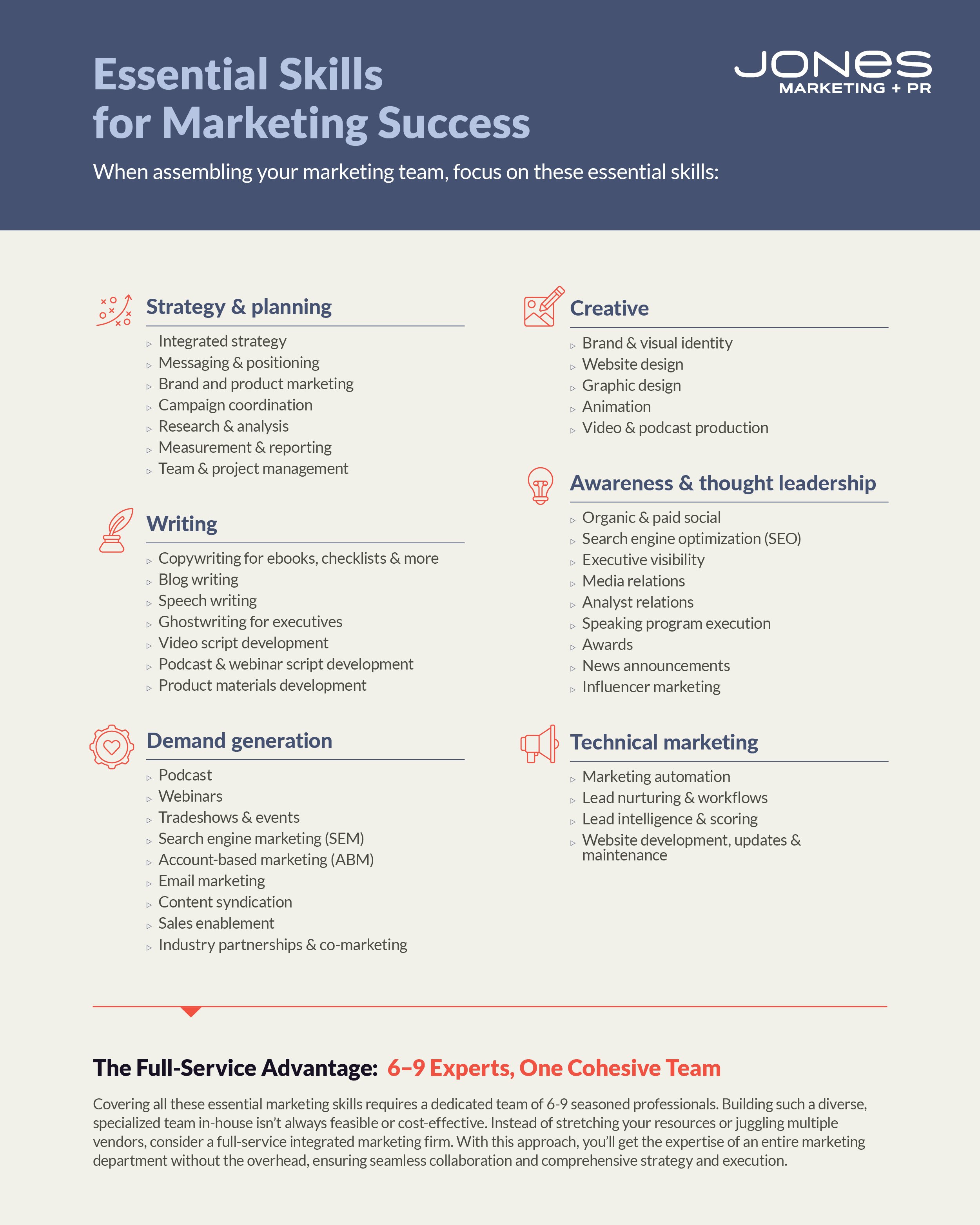
We've mapped the essential marketing capabilities into six categories (see the full breakdown in our Essential Skills for Marketing Success infographic above).
Here's what they look like in practice for B2B tech:
1. Strategy and planning: This covers integrated strategy, messaging and positioning, brand and product marketing, campaign coordination, research and analysis, measurement and reporting, and team and project management. For B2B tech, this is where your go-to-market narrative gets built. If this function is siloed from execution, the strategy never fully translates.
2. Creative: This includes brand and visual identity, website design, graphic design, animation, and video and podcast production. In B2B tech, where your brand competes against companies with deep creative resources, a disconnected creative function shows up fast in inconsistent assets and diluted brand presence.
3. Writing: This spans copywriting for ebooks and checklists, blog writing, speech writing, ghostwriting for executives, video script development, podcast and webinar script development, and product materials development. For marketing leaders trying to build executive visibility and thought leadership programs, this is often the first bottleneck. Quality writing at the volume B2B tech demands is hard to staff. And the growing flood of AI-generated content is making it harder to stand out, not easier.
There's nothing wrong with using AI as a tool to sharpen your thinking, pressure-test a headline or find a better way to frame an argument. Smart writers do that. But there's a meaningful difference between using AI to elevate human expertise and handing the keys to a prompt and calling it thought leadership. Buyers can tell. Journalists can tell. Analysts can definitely tell.
The companies winning the thought leadership game right now are the ones pairing real subject matter expertise with skilled writers who understand the market, the audience and the executive's actual point of view. AI can make good writing better. It can't manufacture authority from scratch.
4. Awareness and thought leadership: This skill set encompasses organic and paid social, SEO, executive visibility, media relations, analyst relations, speaking program execution, awards, news announcements and influencer marketing. This is the category most often fragmented across multiple specialist vendors, and the one where fragmentation causes the most damage. When your PR firm doesn't talk to your content team, and neither talks to the team managing analyst relations, your brand narrative fractures.
5. Demand generation: This includes podcasts, webinars, tradeshows and events, SEM, account-based marketing, email marketing, content syndication, sales enablement, and industry partnerships and co-marketing. For B2B tech with long sales cycles and buying committees, demand gen only works when it's connected to your content strategy, your brand positioning and your sales team's needs.
6. Technical marketing: This covers marketing automation, lead nurturing and workflows, lead intelligence and scoring, and website development, updates and maintenance. This is where the data lives, and if your technical marketing function isn't integrated with the teams creating content and running campaigns, you're making decisions on incomplete information.
What "Full Stack" B2B Tech Marketing Actually Requires
The Real Question Isn't "Do We Have the Skills?" It's "Where Should They Live?
Most B2B tech marketing leaders I work with aren't struggling because they have a bad team. They're struggling because they're trying to cover six categories of specialized work with a team built for three, and filling the gaps with a patchwork of freelancers and specialist agencies that don't talk to each other.
That's the fragmented model, and it creates its own set of problems: inconsistent messaging, duplicated effort, strategic gaps that nobody owns, and a CMO who spends more time coordinating vendors than driving strategy.
The alternative is to pair your in-house team's strengths with a single integrated agency partner that can flex across all six categories. Not to replace your team, but to fill the gaps with people who already work together, already share context, and can move from strategy to execution without the handoffs and translation loss that come with managing multiple firms.
When the team writing your executive's bylined articles is the same team running your demand gen campaigns and managing your HubSpot workflows, the whole program gets sharper. Messaging stays consistent. Content fuels multiple channels. And you stop spending your time as a traffic cop between disconnected vendors.
Where Are Your Gaps?
The infographic above is a useful self-assessment. Walk through each of the six categories and ask yourself: is this covered in-house, outsourced to a partner who's connected to the rest of our program, or is it a gap we're working around?
If you find yourself working around more gaps than you're comfortable with, or if the gaps are covered but by disconnected vendors who don't share context, it might be time to rethink the model.
Perhaps a full-service, integrated agency is the way to go for specific skills and projects, including data analysis or audits.
As always, you're welcome to book time on my calendar here to discuss your needs.







%20-%20Header.jpg?width=352&name=What%20B2B%20Tech%20Marketers%20Are%20Doing%20in%202022%20(infographic)%20-%20Header.jpg)