

You've approved the budget for an original research program. The survey is scoped, the team is assembling and the timeline is taking shape. This is the point where most CMOs step back and let the team execute.
It's also the point where most survey investments start to underperform.
Not because the research is bad. Because the handful of decisions that determine whether this survey produces one report or 18 months of content, media coverage and pipeline activity are about to be made without you.
When original research is planned and executed well, it is one of the highest-ROI investments B2B tech marketing and comms leaders can make.
You Already Know What's at Stake
Thought leadership campaigns deliver a 156% ROI, roughly 16X greater than the return from a typical marketing campaign. The vast majority of B2B tech marketing and comms leaders—88%—see positive ROI from research-driven campaigns, and more than 1 in 10 report conversion rates exceeding 40%.
But those returns aren't automatic. They go to the original research programs that are planned and executed to produce 12 to 18 months of content, media coverage and pipeline activity—not just a single flagship report.
Approximately 70% of B2B tech marketing leaders say they are facing increased pressure to prove ROI. CFO pressure has surged 52%, board pressure has risen 21% and CEO scrutiny has climbed 20%.
When you're under constant pressure to prove your team's value, an original research program that produces one report and a handful of media hits will not survive the next budget cycle.
Conversely, an original research program that can demonstrate pipeline influence, marketing-influenced revenue, improved win rates and compounding brand authority year over year doesn't need to fight for budget.
That is the real goal. A research program you can sustain and scale because you can prove it delivers.
Add to that, the companies that build the most defensible competitive positions with original research conduct annual research, build on previous findings, track trends and create a body of proprietary data that grows more authoritative and harder to replicate every year.
My team has been designing and executing original research programs for B2B tech companies for more than 20 years. The difference between a survey that delivers and one that disappoints almost always comes down to whether the marketing leader stayed involved at the right moments or stepped away too early. Candidly, it also comes down to whether the research, content, PR and marketing strategies are being managed by a single agency partner or scattered across multiple agencies that aren't talking with each other. (More on that as we get into the process.)
Where Your Involvement Changes the Outcome
Here are six moments in the process where you, as the head of marketing, need to remain involved if you want a research program that proves its value and funds itself year after year.
1. Insist that all stakeholders are in the initial planning session.
Before a single question is written, you need to get all of the stakeholders in the room. Sales should share what they're hearing in the field—what prospects are asking, what objections keep coming up and what they are hearing about competitive solutions. Product and product marketing need to come prepared with capabilities launching during the next 12 months that could benefit from data to support the launch. Leadership should help identify where the company's strategic narrative needs proof points.
You convene the meeting. Your agency partner helps guide the conversation toward the inputs that will shape the multi-report strategy. This is the conversation that determines which report topics to strategically prioritize, and that's what shapes the questions.
This is a checkpoint where most survey programs quietly fail. When only the research team plans the survey, questions get designed to fill a single report or to generate a few mediagenic data points, not to fuel 12 to 18 months of content. The topic may be interesting, but is it strategic? Does it have legs beyond one launch asset?

2. Approve the report outlines, takeaways and target statements before a single question is written.
This is another important step in the process. The stakeholder input from step one needs to become a full architecture of what the research is designed to produce. That means your agency partner maps out every report the survey will support. Not just one report, but all four, five or six of them, complete with working titles, themes and release timing tied to your business calendar (e.g. conferences and tradeshows, product launches or other key events).
Once you're aligned on the reports, your agency partner prepares detailed section outlines for each report, including the story each section needs to tell and the specific data-backed statements you want to be able to make in each section.
Before you give final approval, circulate the full report strategy—themes, timing and target statements—back to the stakeholders from step one. This is their chance to confirm the architecture reflects what they brought to the table and flag anything that's missing. When stakeholders see their input in the plan, they're more invested in the output.
Most teams skip this step and jump to writing survey questions. I get the temptation, but don't. Yes, it takes time and may initially slow the process. However, the rest of the process moves faster because the planning is already done. Every week you invest in report architecture, statement mapping and stakeholder alignment on the front end, will save you months of wasted content, missed media windows and underperforming campaigns on the back end.
When you sign off on this architecture, you are confirming that the research will support the stories, proof points and content the business needs for the next 12 to 18 months. Everything downstream depends on this approval.
3. Make sure whoever designs the survey questions is the same team creating the content.
You have the report outlines, the section stories and the target statements. Now comes the question that quietly makes or breaks the whole program: who designs the survey?
Standalone research firms can design great surveys but have no connection to your content strategy, PR plan or sales enablement goals. They also don't understand the nuances of your business, your messaging or the specific stories you're trying to tell.
Content and PR agencies understand the stories you need to tell but don't have the research experience to design a survey that delivers usable data. Survey writing is its own discipline—question structure, response design, sample methodology—and getting it wrong undermines everything downstream.
This is one of the clearest examples of why working with a single integrated, full-service agency partner changes the outcome. When the same team that built your report architecture in step two also designs the questionnaire, every question gets reverse-engineered from the statements you've already approved.
Compare that to what happens when you're coordinating between a research firm, a content agency and a PR firm. The research firm writes questions based on what they think is interesting. The content team then tries to build stories from data that wasn't designed for their purposes. And the PR team is pitches media with findings that are mediagenic but don't necessarily map to the company's strategic narrative. Everyone does good individual work, but the output doesn't connect.
At JONES, we've designed, executed and promoted more than 100 surveys for B2B tech companies. I can confidently say, when research design, content strategy and creation, and media relations all sit under one roof, the data comes back ready to use, rather than ready to interpret.
Here's my advice: before the survey is programmed, review the full question set against the report architecture you approved in step two. For each question, ask:
-
Will this produce the data-backed statement(s) we need?
-
Does every report section have questions designed to support it?
-
Are there gaps?
-
Are there questions that don't map to any approved section?
Then take the survey yourself. If a question confuses you, it will confuse your respondents. Could anything be misunderstood in a way that gives you data you can't use? Once you're satisfied the questions will deliver on the architecture, approve them and give the green light to field the survey.

4. Review the data findings against every planned report before content creation begins.
The survey has been fielded and the data is in. Before anyone starts writing, you need to know whether the data actually delivered on the architecture you approved in step two.
This is the step most teams skip entirely. The data comes in, the team gets excited about the top-line findings and starts drafting the first report. Nobody stops to systematically validate whether the data supports every report, every section and every statement across the full plan.
Your agency partner should present a readout for each planned report. Section by section, how does the actual data map to the outline? Which target statements does the data confirm? Which ones did it not support, and how does that change the story? Where the data didn't support the original assumptions, your agency partner should flag the gaps and recommend how to adjust.
This is another place where the integrated model pays for itself. When your research team and content team are separate organizations, the handoff here is where context gets lost. When the same team that designed the research is also building the content, validation happens naturally because they already know what the data needs to deliver.
This readout also confirms how the data maps to your release calendar. Which findings go with which report, and when does each one go to market? The report architecture from step two already established the themes and timing. Now the readout confirms that the actual data supports that plan, and ensures everyone is clear on what data gets released, in which report, on which date.
Then ask one more question: what did the data reveal that wasn't in the original plan? The most valuable findings are often the ones nobody anticipated: surprising demographic breakdowns, counterintuitive cross-tabs, unexpected patterns that warrant an additional report, a deeper dive within an existing report or a standalone blog post.
We've seen unexpected findings fuel some of our clients' strongest media coverage and sales conversations. But that only happens when the team goes beyond validating what was planned and starts exploring what else the data has to say.
Before you approve the content creation timeline, circulate the updated report strategy back to the stakeholders from step one. Sales needs to know if the proof points they were expecting landed. Product needs to see whether the data supports the capabilities they flagged. This is the same alignment process from step two, just now with real data instead of planned architecture.
Once stakeholders have been briefed on the updated plan, review and approve the final report strategy. From there, your agency partner develops the report and builds the detailed campaign plan and asset checklist for the first wave of content.
5. Review the asset checklist and campaign plan for the first wave of content.
Your agency partner has built the campaign plan and asset checklist for the first report. Before content production begins, review both.
The campaign plan maps how this report connects to the specific event, product launch or strategic moment it was designed to support. It should also outline how marketing automation will move report downloaders through the funnel and how the next report release will re-engage contacts who downloaded or engaged with this initial report.
Research shows that prospects who engage with five or more content pieces convert at 5x the rate of those who consume a single piece. Your staggered release calendar is designed to create exactly that kind of repeated engagement, giving prospects multiple reasons to come back to your data over 12 to 18 months. The first report sets that flywheel in motion.

The asset checklist ensures the data in this report gets used everywhere it should be. Your agency partner should identify every asset and activation the report's data will support. Not after the report is written. Before. This is the accountability tool that prevents the most common failure in survey programs: publishing a great report and leaving 90% of the content opportunity on the table.
When you review the checklist, expect to see, at minimum: the report itself, a press release, blog posts pulling key findings, bylined articles for industry media, infographics, point-of-view videos where executives discuss findings, sales deck updates with new proof points, sales enablement one-pagers and talking points, email nurture sequences driving to the gated report, social media content and updates to key website pages with fresh statistics.
Everywhere the data can be used, it should be used. The checklist is what makes that happen. From here, your agency partner (and internal team members if they have bandwidth) gets to work creating the first report and all of the corresponding assets you just approved.
This same process repeats for every report on your release calendar.
6. Set your measurement targets, review results across four levels and build the case for next year.
The first report is in market. The campaign is running. Now the question your CEO, CFO and board will ask: was it worth it?
Before you can answer that, you need to define what success looks like. If you haven't already set specific targets for this research program, do it now, before the first results come in.
Decide what pipeline numbers, engagement benchmarks, media coverage targets and brand authority metrics would justify the investment and fund the next round of research. Then measure against them.
Make sure your team has implemented a 'research-influenced' tag in your CRM/MA platform, applied at both the contact level and the opportunity or account level. Every contact who downloads the report, registers for a research webinar, clicks through a research email or engages with media coverage of your findings should be tagged. When those contacts are associated with open opportunities, the opportunity gets tagged too. This is how you report on both the individuals engaging with your research and the deals your research is helping to close.
You should be able to track and present results on four levels:
1. Content performance. How many distinct content pieces came from this report? Downloads of the gated report, blog traffic, webinar attendance, social engagement, time spent on research pages. Then measure the individual pieces created from the data: blog posts, infographics, social snippets, bylined articles. Are they driving engagement back to the source report?
Original research is consistently rated one of the most effective formats for driving engagement and leads, with 93% of B2B tech marketing leaders saying it effectively drives both.
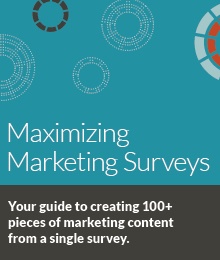
A well-planned survey program should produce more than 100 pieces of content across all reports. Read our guide, Maximizing Original Research, for ideas on how one survey can fuel 100-plus content concepts and more than 1,000 social media posts.)
2. Pipeline and revenue. Compare your research-influenced cohort against the rest of your pipeline. Track MQL-to-SQL conversion rates for contacts who entered the funnel through research content versus other inbound sources.
Measure pipeline created or influenced by the research: the number and value of opportunities where the contact or account engaged with any research asset in the 30 to 90 days before opportunity creation. Then measure velocity and win rate. Are research-influenced deals closing faster? At higher contract values?
Research from Forrester shows that 82% of buyers view five or more content pieces from the winning vendor before making a purchase decision. Your multi-report strategy is designed to be those five-plus touchpoints.
3. Earned media. Is your research generating media coverage, and is that coverage building your position in the market? Track the number and quality of media hits tied specifically to your research. Measure share of voice relative to competitors. Are your executives being cited, quoted or invited to speak because of the data? Are industry publications referencing your findings?
Track backlink growth and branded search lift. You want to be able to say this research is how we own the narrative about this problem in this market. Then connect that coverage back to pipeline. For example, are there deals where sales used media coverage of your research as social proof?
4. AI visibility. This is the measurement layer most CMOs are still missing, and it directly affects whether your research shows up where your buyers are actually looking. Track how often AI search platforms (ChatGPT, Gemini, Perplexity, Claude) recommend, mention, or cite your company and your research for priority buyer prompts in your category.
Monitor LLM referral traffic and conversions by source: visits, form fills, opportunities seeded by AI engines like Perplexity and ChatGPT, and note whether those answers draw directly from your research assets or from earned media coverage that reports on your findings.

Leading B2B tech PR measurement frameworks now treat AI visibility as a core performance metric. If your research is generating earned media, and that coverage is showing up in AI‑generated answers, you gain a compounding visibility advantage that owned content alone is unlikely to replicate, because AI models heavily favor credible, third‑party sources in their citations.
This is worth pausing on, because it connects directly to the integration question. When your research program, content strategy, earned media and demand gen are managed by separate firms, no one has the full picture to measure across all four levels. You end up with siloed reports from each agency and no unified view of how the research is actually performing. An integrated partner can connect the dots from content engagement to media coverage to pipeline influence to AI visibility, because they're managing all of it.
Ask your sales team directly: are you using the research in conversations, proposals and RFPs? Are the proof points making their way into pitches? If the sales team has fresher, more credible data points than the competition, that should show up in shorter sales cycles and higher close rates.
High-value B2B deals can involve hundreds of touchpoints across extended sales cycles, so no single metric tells the full story. Pull all of this from a single, consistent attribution model in your CRM/MA platform, so every research touch is tracked at both the contact and opportunity level and can be rolled up cleanly for the C‑suite.
When you present to the C-suite, roll it up into one view: here is what we spent on this research program. Here is the pipeline and revenue it influenced. Here is the earned media coverage it generated and the category position it built. Here is how it shows up in AI search. Net result: this research program delivered $X in pipeline, $Y in revenue and a cost per qualified opportunity that is Z% lower than our average campaign.
This measurement process repeats with every report release. Each new report should re-engage contacts from previous reports and add new contacts to the funnel. Every measurement cycle should include cumulative results from all previous reports, not just the latest release. Earlier reports will continue generating downloads, media coverage and pipeline activity long after publication. Measuring the full program, not just the newest report, is how you capture the compounding ROI that enables you to justify continued investment in the research program.
The most successful B2B tech companies we work with treat original research as an ongoing program, not a one-time project. They field new surveys annually, building on previous findings, tracking trends over time and creating a body of proprietary data that compounds in value. Each year the research becomes more authoritative and results increase.
If you want to talk through how to build a research program that delivers for the next 12 to 18 months, I'd welcome the conversation. You can grab time on my calendar here.